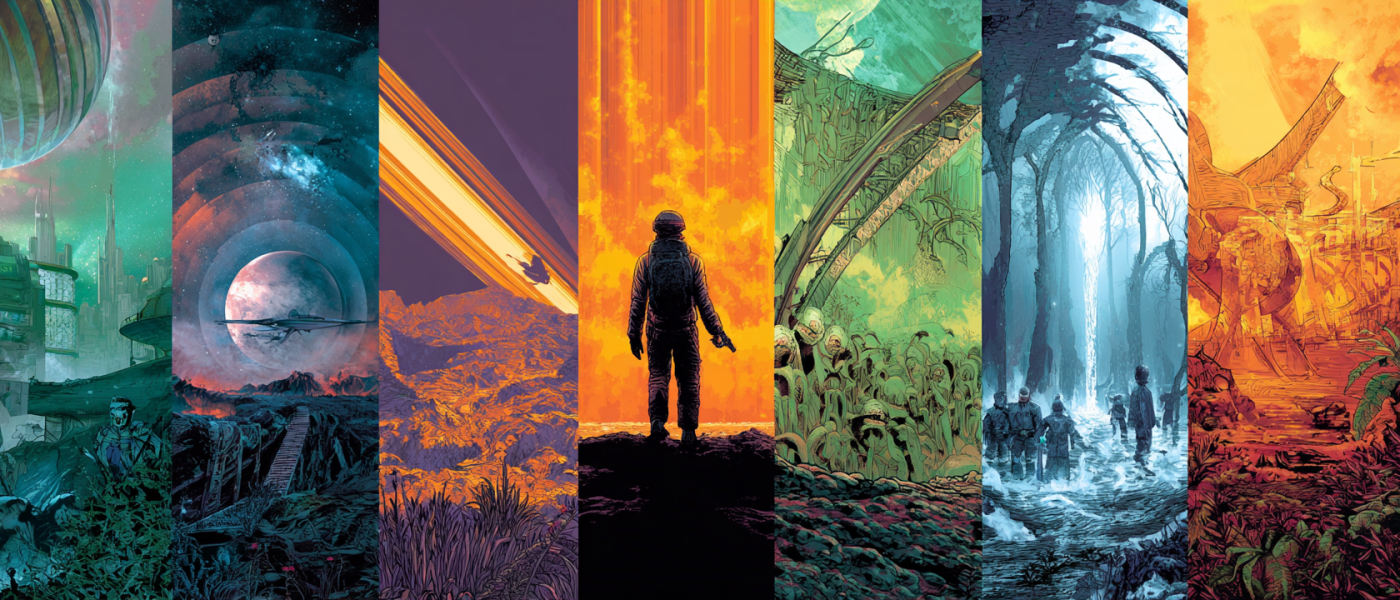
Like fantasy, science fiction has fractured into countless subgenres. The spaceship adventures of the Golden Age are still here, but they've been joined by dozens of other flavours. Here's your map.
Space Opera
Big canvas, high adventure. Interstellar civilisations, grand conflicts, operatic drama. Less concerned with scientific accuracy than with sweep and spectacle. Think Iain M. Banks' Culture novels, Peter F. Hamilton's Void trilogy, The Expanse, Dune.
Try if: You want scope, action, and the thrill of the vast. You're not bothered by handwaved physics.
Skip if: You want rigorous scientific grounding or intimate character studies.
Hard Science Fiction
As scientifically accurate as possible. The author has done the maths. Physics, biology, engineering — all plausible, all extrapolated carefully. Think Kim Stanley Robinson, Greg Egan, Andy Weir's The Martian.
Try if: You want to learn while you read. You find scientific accuracy more immersive than less. You enjoy problem-solving protagonists.
Skip if: You find technical details slow or alienating.
Cyberpunk
High tech, low life. Corporate dystopias, hackers and street criminals, the fusion of humanity and technology. Neon-drenched, noir-influenced, often bleak. Think William Gibson's Neuromancer, Blade Runner.
Try if: You like your futures gritty and your technology ambivalent. You enjoy noir sensibilities.
Skip if: You want optimistic visions of technology or escapism.
Solarpunk
The optimistic response to cyberpunk. Sustainable futures, community-oriented, technology in harmony with nature. Emerging subgenre. Think Becky Chambers, Kim Stanley Robinson's Ministry for the Future.
Try if: You want hope. You want to imagine futures worth living in.
Skip if: You find optimism naive or insufficiently dramatic.
Military Science Fiction
War in space. Often focused on soldiers, tactics, the camaraderie and trauma of combat. Ranges from gung-ho to deeply critical. Think Starship Troopers, The Forever War, Old Man's War.
Try if: You enjoy action and tactical thinking. You're interested in how war might evolve.
Skip if: You find military settings uninteresting or glorified violence troubling.
First Contact
Humanity meets aliens. The central question: how do we communicate with truly alien intelligence? Think Carl Sagan's Contact, Arrival (based on Ted Chiang's short story), Solaris.
Try if: You're fascinated by communication, consciousness, and the limits of understanding.
Skip if: You want your aliens to be basically humans with weird foreheads.
Dystopia / Post-Apocalyptic
The future gone wrong. Either totalitarian societies (1984, The Handmaid's Tale) or collapsed ones (The Road, Station Eleven). Warnings about where we might be heading.
Try if: You want science fiction that comments sharply on the present. You don't need hope to be engaged.
Skip if: You want your fiction to offer escape from existential dread, not more of it.
Generation Ship / Colony Ship
The long journey. Humanity leaves Earth on voyages that take centuries. Stories often span generations, exploring how societies evolve in enclosed spaces. Think Aurora, Children of Time.
Try if: You're interested in social dynamics, long-term thinking, and contained ecosystems.
Skip if: You want fast-paced action or stories that stay with one protagonist.
Time Travel
Playing with causality. Paradoxes, alternate timelines, the implications of changing the past. Think The Time Machine, The Time Traveler's Wife, Dark (the TV series).
Try if: You enjoy brain-bending logic puzzles and "what if" scenarios.
Skip if: You find temporal paradoxes frustrating rather than fun.
Near Future / Mundane SF
Tomorrow, not a thousand years from now. Technology just slightly beyond current capabilities. Often focused on social implications. Think Black Mirror, much of Cory Doctorow's work.
Try if: You want science fiction that feels immediately relevant to your life.
Skip if: You want the imaginative distance of far-future settings.
Biopunk / Genetic SF
What happens when we redesign life itself? Gene editing, designer organisms, post-human biology. Think Oryx and Crake, Altered Carbon, Never Let Me Go.
Try if: You're interested in questions of identity, embodiment, and what it means to be human.
Skip if: Body horror makes you uncomfortable.