
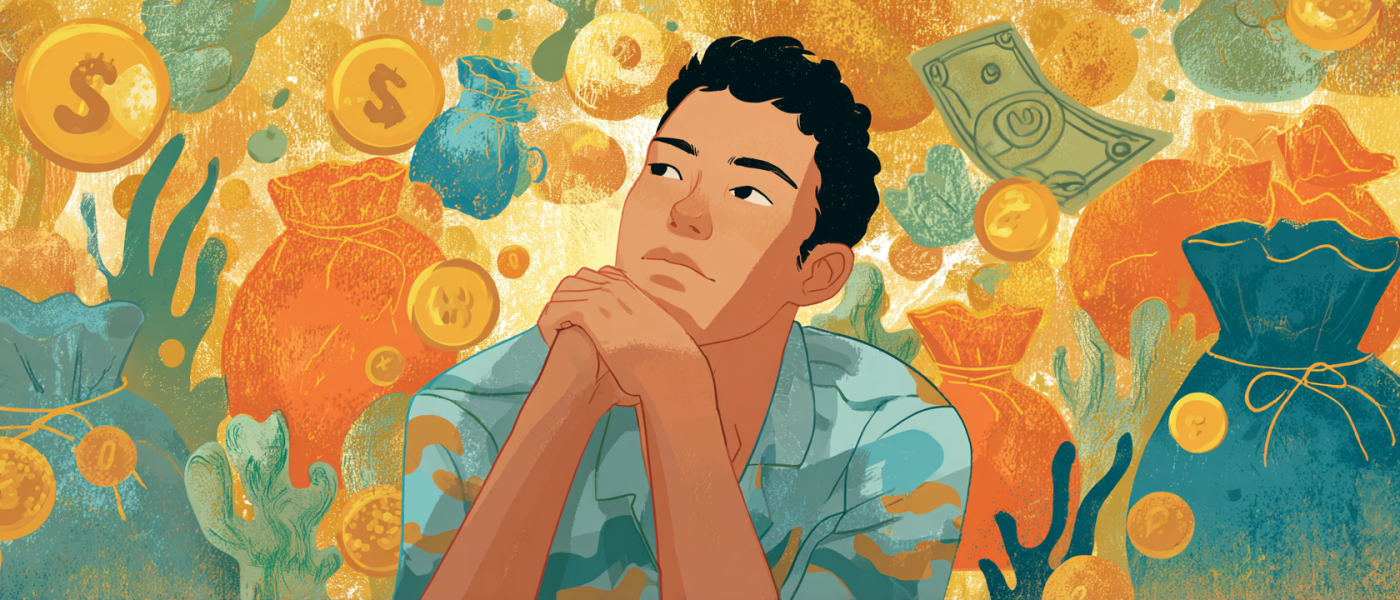
You're chasing something right now that you don't actually want.
I don't know what it is. The promotion. The lifestyle. The relationship status. The home in that neighbourhood. But statistically, at least one of your major life goals was borrowed from someone else.
You absorbed it without realising. And now you're spending your finite time and energy pursuing it as if it were yours.
This isn't an insult. It's just how we human beings work.
We learn what to want
The French thinker René Girard spent his career studying what he called mimetic desire. His core insight was simple but unsettling: we don't generate our desires independently. We absorb them from others.
Watch a toddler in a room full of toys. She'll ignore them — until another child picks one up. Suddenly, that toy becomes desperately desirable. Not because of the toy's qualities, but because someone else wants it.
We like to think we grow out of this. We don't. We just get better at hiding it.
The adult version looks like this: a colleague gets promoted, and suddenly you want that promotion too. A friend buys a house, and suddenly renting feels inadequate. Someone on Instagram has a lifestyle that looks appealing, and suddenly your life feels lacking.
The desire feels authentic. It feels like it's coming from inside you. But trace it back, and there's usually a model — someone who wanted it first.
The mimetic trap
This wouldn't matter much if borrowed desires made us happy. But they often don't.
When you achieve a mimetic goal, the satisfaction is hollow. You got the thing, but the thing was never really the point. The point was keeping up, measuring up, not falling behind. And there's always another rung on that ladder.
Meanwhile, the desires that might actually fulfil you — the quieter ones, the ones that don't come with social validation attached — get drowned out by the noise.
You end up building a life that looks impressive but doesn't fit. A life optimised for other people's metrics.
The way out
The good news is that awareness changes everything.
Once you can see mimetic desire operating — really see it, not just intellectually but as a felt recognition — you gain choices you didn't have before.
You can ask: Where did this desire come from? Whose example am I following? Would I want this if no one else had it?
You can learn to distinguish borrowed desires from authentic ones. The borrowed ones usually feel urgent, competitive, anxious. The authentic ones tend to be quieter, more persistent, less dependent on external validation.
You can choose your influences more deliberately, rather than absorbing whatever happens to appear in your feed.
None of this is quick or easy. The patterns are deep. But they can shift.
More to come
Over the next few weeks, I'll be sharing more about mimetic desire and how to work with it: how social media amplifies the problem, practical exercises for identifying your own patterns, and frameworks for cultivating desires that are actually yours.
I've also written a short book on the topic — Someone Else's Dream — for anyone who wants to go deeper. More on that soon.
For now, just notice. The next time you feel a strong pull toward something, ask yourself: Is this mine? Or did I borrow it?
You might be surprised by the answer.