
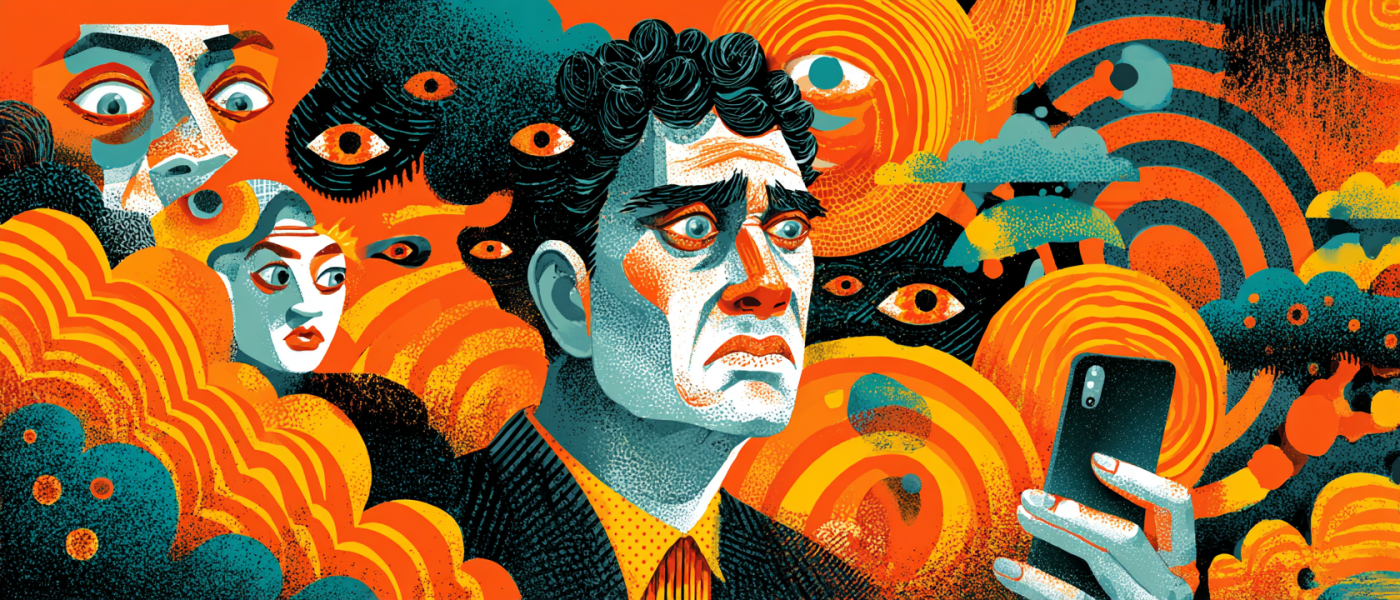
You already know social media can make you feel bad. That's not news.
But the usual explanations — it's addictive, it's a time sink, the content is toxic — miss the deeper mechanism. They describe the symptoms without diagnosing the disease.
The real problem is mimetic.
A machine built for comparison
Social media platforms make money by capturing attention. The more time you spend scrolling, the more ads they can show you. So they've optimised, ruthlessly, for engagement.
And what engages us most reliably? Seeing what other people have.
The like button is a pure mimetic signal: other people found this desirable. Follower counts are mimetic scoreboards. Trending sections tell you what everyone else is paying attention to. The whole architecture is designed to show you, constantly, what others want — so you'll want it too.
Before social media, your comparison pool was limited. A few dozen people: neighbours, colleagues, family. You encountered their lives sporadically, through direct contact.
Now you can compare yourself to millions. Constantly. First thing in the morning and last thing at night. And you're comparing yourself to their highlight reels.
The collapse of distance
The thinker René Girard distinguished between two types of imitation. When your model is distant — a celebrity, a historical figure, someone clearly in a different league — the imitation is relatively safe. You can admire them without it curdling into envy.
But when your model is close — a peer, someone you could actually compete with — the dynamic becomes volatile. Admiration easily tips into resentment. You're not just inspired; you're threatened.
Social media has collapsed this distance.
That influencer with a million followers? They share their morning routine and reply to comments. They feel accessible, relatable. Like a peer.
That former classmate who just posted about their promotion? They're right there in your feed, alongside your actual friends.
Everyone becomes a potential rival. Everyone's success becomes a comment on your own inadequacy.
The outrage angle
It's not just envy. Social media also weaponises mimetic desire through outrage.
When you see your in-group united against a target, you want to join in. The denunciation is contagious. Piling on becomes a way of proving you belong.
This is an ancient human mechanism — Girard called it scapegoating — but social media has scaled it globally and accelerated it to real-time.
The platforms reward this because outrage drives engagement. The cycle intensifies. And we're all a little angrier, a little more tribal, as a result.
What to do about it
I'm not going to tell you to delete your accounts. That's a legitimate choice, but it comes with real costs, and it doesn't actually solve the underlying problem. You can still be caught in mimetic traps without social media.
What helps more is awareness.
When you notice that prickle of envy at someone's post, name it. I'm feeling envious. This is a mimetic trigger. The naming creates distance.
When you feel the pull to join a pile-on, pause. Ask whether you'd feel this strongly if you hadn't seen everyone else feeling it.
Curate ruthlessly. Every follow is an invitation to comparison. Be deliberate about who gets access to your attention.
And remember: you're not seeing reality. You're seeing a feed optimised to make you feel inadequate enough to keep scrolling.
Going deeper
This is just one piece of a larger puzzle. Mimetic desire operates through all of life, not just social media. Understanding it is one of the most useful things you can do for your own wellbeing.
I've been writing about this more in my book Someone Else's Dream. But even without the book, you can start noticing. The mechanism is always running.
Next time you scroll, watch yourself. Notice what triggers you. Notice the pull.
That's the first step out.