
I've always believed that the best way to understand something is to build it. When I wanted to understand political ideology, I built Political Circle. When I wanted to understand how language shapes thought, I built Babel Tales.
And when I wanted to understand how people actually learn languages — not in theory, but in practice — I built toki suli.
It started with toki pona.
toki pona is a constructed language with only 137 words. It was created by Canadian linguist, Sonja Lang, and it's built around a beautifully radical idea: what if a language forced you to think simply? With so few words, every sentence becomes a small act of composition. You can't be vague. You can't hide behind jargon. You have to mean what you say.
I was fascinated by this — partly as a writer, partly as someone who spends a lot of time thinking about how minds work. So I built an app that teaches toki pona one word per day. One word. That's your lesson. Come back tomorrow for the next one.
It was how I taught myself the Futhorc runes a couple of years ago, and it worked well. I recall them much better than a lot of stuff I 'learned' on Duolingo, even though I rarely look at them.
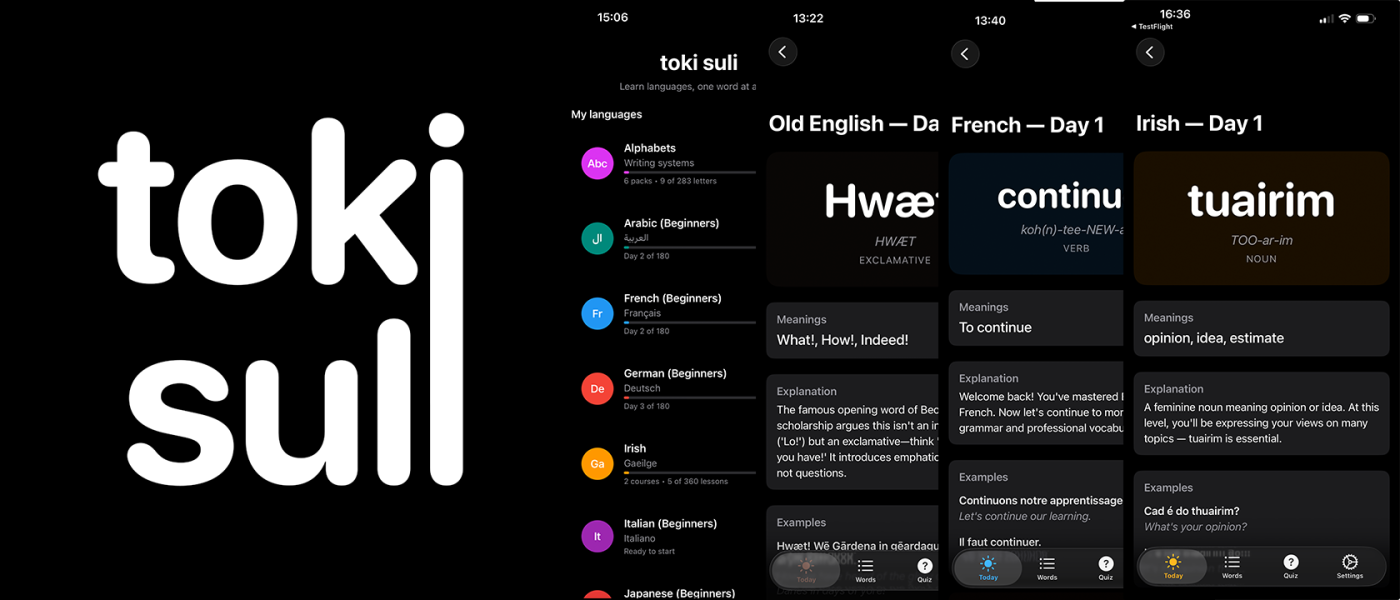
And toki suli seems to work really well. One word per day is small enough to be sustainable and focused enough to actually stick. No grammar dumps. No overwhelming lesson plans. Just a single word, with a clear explanation, pronunciation, examples, and a grammar note when it's relevant. Plus the option to test yourself when you please.
So I thought: why stop at one language?
toki suli — which means "important language" in toki pona — is now a series of language courses, each built on the same principle. 180 words. One per day. Six months from knowing nothing to having a real foundation.
The first expansion was Irish. Then French, German, Italian, Spanish, Latin, Japanese. And because I can never resist the weird ones: Old English, complete with þ (thorn) and ð (eth) and all the lost letters your keyboard doesn't have. I'm a big supporter of bringing back thorn into everyday use.
Each course is available in þe toki suli app. þe app is free to download, and þe toki pona and Fuþorc runes packs come pre-installed, so you can test þe app fully. (OK, enough with the thorns!)
I'm publishing them as books too — starting with toki pona, Beginner Irish, Beginner French and, hot off the press, Beginner Old English. I'll publish the rest over the coming weeks and months. Same content, same method, just on paper for people who prefer it.
What surprised me most about this project is how much it taught me about my own craft. Every language encodes a different way of thinking. In Irish, you don't have things — they're at you. You're not hungry — hunger is on you. In Old English, you can watch modern words dissolving backwards into their thousand-year-old ancestors, and suddenly etymology isn't abstract any more. In toki pona, you learn what happens when a language refuses to let you be complicated.
These aren't just linguistic curiosities. They're world-building tools. They're character tools. They're ways of understanding that people in different places and times didn't just speak differently — they thought differently. And if you're writing fantasy and sci-fi, that matters.
While I've been working on the latest edit of my fantasy novel, I've been tinkering with developing two languages. They don't appear in the book, but understanding the background and the conflicts that have caused them is crucial in the second book (which still remains 1/4 written...). But it does allow me to add depth and flavour to the first book.
There's something deeply satisfying about the one-word-a-day approach. It's patient. It's cumulative. It trusts that small things, done consistently, add up to something real. Just like how we write novels too, come to think of it. One word at a time.